Imagine this: you’re on the final stretch of a race you are running, sprinting to the end, finish line in sight, competitors close behind you, but you’re just out of their reach. You can already feel the medal around your neck, and the adrenaline is pumping. You’re one step away- and then suddenly, it’s gone. The win, the race, the joy. All of it stripped away and replaced with agonizing pain.
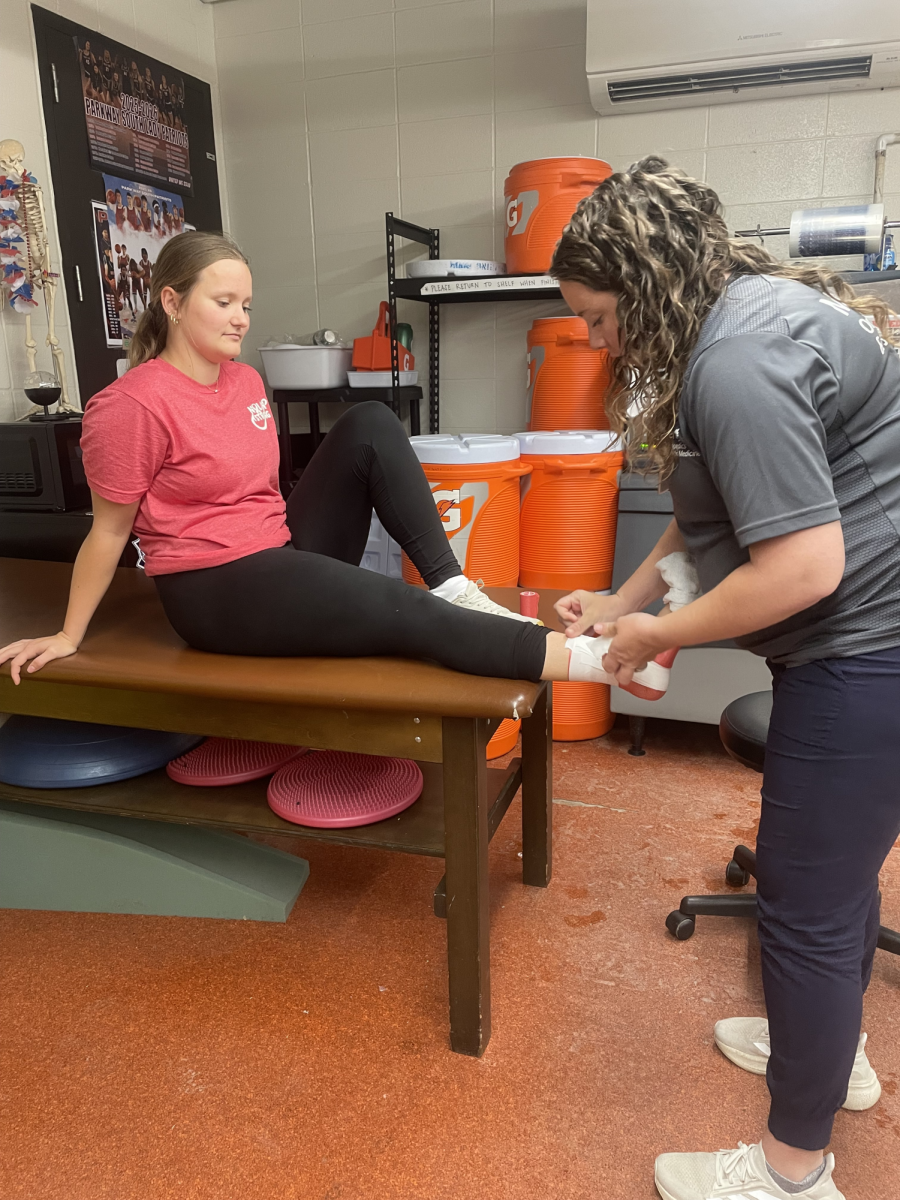
Unfortunately, this situation is the truth for many athletes. Many student athletes experience a debilitating injury every year while playing their sport, and freshman Aaliyah Krzyanowski is one of them. Not long before the start of her new club lacrosse spring season, Krzyanowski, who at the time was 13 years old, suffered a heartbreaking shoulder injury during her winter season.
“I basically injured my shoulder playing a game,” Krzyanowski said. “We don’t know how it happened. It just kind of gradually got worse over time, and I went through this pain for a year until I finally decided to get it checked out from an orthopedic. We got it checked out, and they said I have an issue where my shoulder blade is not in a resting position, it’s kind of winged. And then I also have an overused muscle. So from that, they told me I had to do physical therapy, so I did physical therapy for about six months.”
Lacrosse is a rapidly growing sport in America, with more than a 40% increase in the number of high school girls playing the sport from 2012 to 2022, according to playerdata.com. Despite its exponential growth over the years, lacrosse is a highly physical sport that poses danger to all athletes who participate in it. Lana Korte, a freshman on the South High varsity lacrosse team and teammate of Krzyanowski, mentioned that she sees injuries occur exceedingly often.
“Every single day,” Korte said. “It could be just mainly bruises, or sometimes, if it’s really bad ACL. You get bruised all the time. Especially during games.”
However, lacrosse isn’t the only sport responsible for these injuries. All sports pose a risk of injury, regardless of competitiveness, physical contact level, or equipment and protection used. Freshman Charlotte Moffat was a cheerleader on the JV squad, who will join varsity as a sophomore in the fall. Moffat said that cheer is also a sport where injuries are commonly seen, and near-perfection is necessary to ensure safety.
“I mean, there’s always a possibility of getting hurt,” Moffat said. “We are throwing people up in the air and doing tricks. So, honestly there are so many different kinds of injuries. It’s not just one specific thing. It also depends on if you’re a flyer, a base, or a back spot, because in those different places, there could be different injuries.”
While sports injuries are obviously physically draining for young athletes, some suffer the mental health consequences that are often not mentioned. For many athletes, their sport is their whole world, and losing that to an injury can cause some students to suffer thoughts of identity loss. Athletes can struggle with depression, anxiety, and other mental health issues after an injury that affect their performance in school and their engagement with peers. That’s why it’s vital to rely on the help of others when struggling with the aftermath of an injury and the process of beginning the sport again once cleared for activity.
“My coaches specifically, they helped me a lot through the recovery process and at practices when I would need to take a break,” Krzyanowski said. “They would always be super supportive, making sure I was only doing what I could. And then my teammates were there with me a lot. They helped me a lot in the off-season, to get ready for the season, kind of catching me up on anything that I might have missed, as well as my family just coming and supporting me in my games, no matter how hard it got through those times”.
While a painful injuries can happen, there are ways to prevent one while playing a physical sport. Wearing protective gear, stretching before and after activity, and resting when necessary are all great ways to stay safe and healthy while playing a sport. Even though a minor or career-ending injury can be extremely devastating, there is a light at the end of the tunnel for young athletes who struggle to find a way out.
“During that process of when you have to sit out or if you’re not playing as much, you definitely need to find yourself in the process and realize you’re more than your sport,” Krzyanowski said. “Your sport is not who you are. It’s not your purpose.”



![“All-Suburban [choir] was really fun because I got to work with a lot of people from other schools that I didn't know and I got to make friends. We got to learn fun but challenging music and perform for my parents so that was really fun. But the audition process was really stressful, because over 600 people auditioned but only around 150 actually made it into the choir so that was really intimidating for me. I was one out of three girls in my class who made it so that made me feel really special and I was really grateful to have this opportunity.”](https://psouthtreaty.com/wp-content/uploads/2026/05/Image_20260523_140845_694.jpeg)