
Lab rats, intended as an experimental journey for students in a classroom, created a bond with their owners and are going home with a completely different role.. A pet! Sounds like a Pixar movie? Well, it’s a little more local.
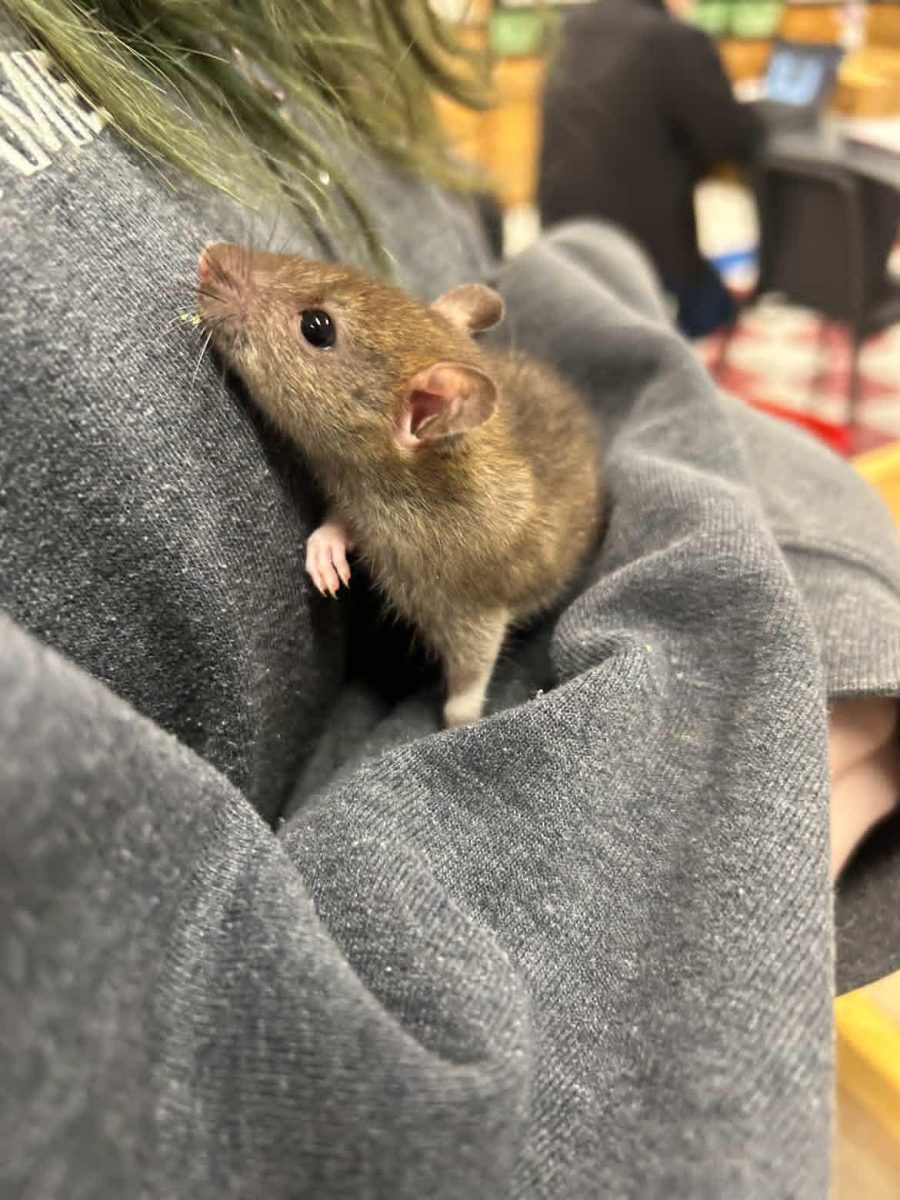
Here at South, the Animal Behavior class, taught by David Richardson, supplied its students with rats–tiny, pink-nosed bundles of joy, to give students hands-on experience with learning, socialization and conditioning. The goal: teach the rat a trick by the end of a one-week period. Bond with the rat, and if you like them enough, take them home with you.
A few students listened to that suggestion, and came out of the classroom with new rodent buddies. But just how did these bonds form? How are they acclimating to their new homes?
Senior Luke Coddington said he and his rat Goose didn’t start bonding immediately.
“My rat was a shy little baby boy in the beginning. And when given the option, would never choose to interact with people,” Coddington said. “But after multiple sessions he began to warm up to each group member and even show preference in who he felt comfortable with. Seeing the rat curled up in the corner of the cage, body trembling slightly from fear. The sheer difference between his behavior from the initial fear, to seeing the rat crawl into my arms and burrow into my jacket broke something in me. How could I let such a small creature go off and become snake food? I couldn’t. I decided then and there he needed to go to a loving home.”
Another person who took his rat home is senior Jackson Hoban.
“I believe it was the same feeling as when you go to the shelter or the adoption center, and you happen to find that one dog, or any animal, honestly, (that) just happens to click with you instantly, and I love that it was the same feeling I had when I saw Spyro for the first time,” Hoban said. “I think Spyro taught me that even the smallest things in life- no pun intended- can make you happy and feel good about yourself.”
These touching stories fueled a question in my head. What would’ve happened to these rats if they weren’t taken home? I asked David Richardson, the teacher who provided this opportunity to his students.
“About three to five rats get taken home each year. Not as many were taken this year, because rats are less popular than the mice we used to do,” Richardson said. “If the rats aren’t taken, they are given back to the pet store (to be sold) as feeder rats or pets. The objective of the lab is for students to understand how to use operant conditioning and classical conditioning to train an animal to do tricks.”
My own rat story?
I was one of those students. I didn’t plan on bringing a rat home. Not until the little guy, named Duck, began curling up into my sleeve. By the end of the week, the idea of leaving him behind felt impossible. Now he and his brother live a very spoiled life, complete with hammocks, tunnels, and a steady supply of yogurt drops!
What started as a science lesson became something more meaningful: proof that connection can form anywhere, even between a teenager and a six-ounce creature with whiskers the size of eyelashes.
Sometimes the best classroom lessons are the ones you take home…. Literally.



![“All-Suburban [choir] was really fun because I got to work with a lot of people from other schools that I didn't know and I got to make friends. We got to learn fun but challenging music and perform for my parents so that was really fun. But the audition process was really stressful, because over 600 people auditioned but only around 150 actually made it into the choir so that was really intimidating for me. I was one out of three girls in my class who made it so that made me feel really special and I was really grateful to have this opportunity.”](https://psouthtreaty.com/wp-content/uploads/2026/05/Image_20260523_140845_694.jpeg)