Walking through the hallways of South High is like traveling past a bunch of countries all at once. Although there is a lot of diversity, a lot of the students are native Spanish speaking.
According to South’s EL teachers, there are 89 students walking the halls who speak Spanish as their primary language. Do you ever wonder if adjusting to the new environment is hard for them, and how they are able to adapt to the new change around them?
Although he was not born in a Spanish-speaking country, science teacher Sergey Zinovchik has a special connection with students who speak a foreign language because he was born in Belarus and was a native Russian speaker.
“I feel very connected to the students, because I, myself, am an immigrant, and I understand them, so I do my best to make sure they are more involved and connected to the class,” he said.
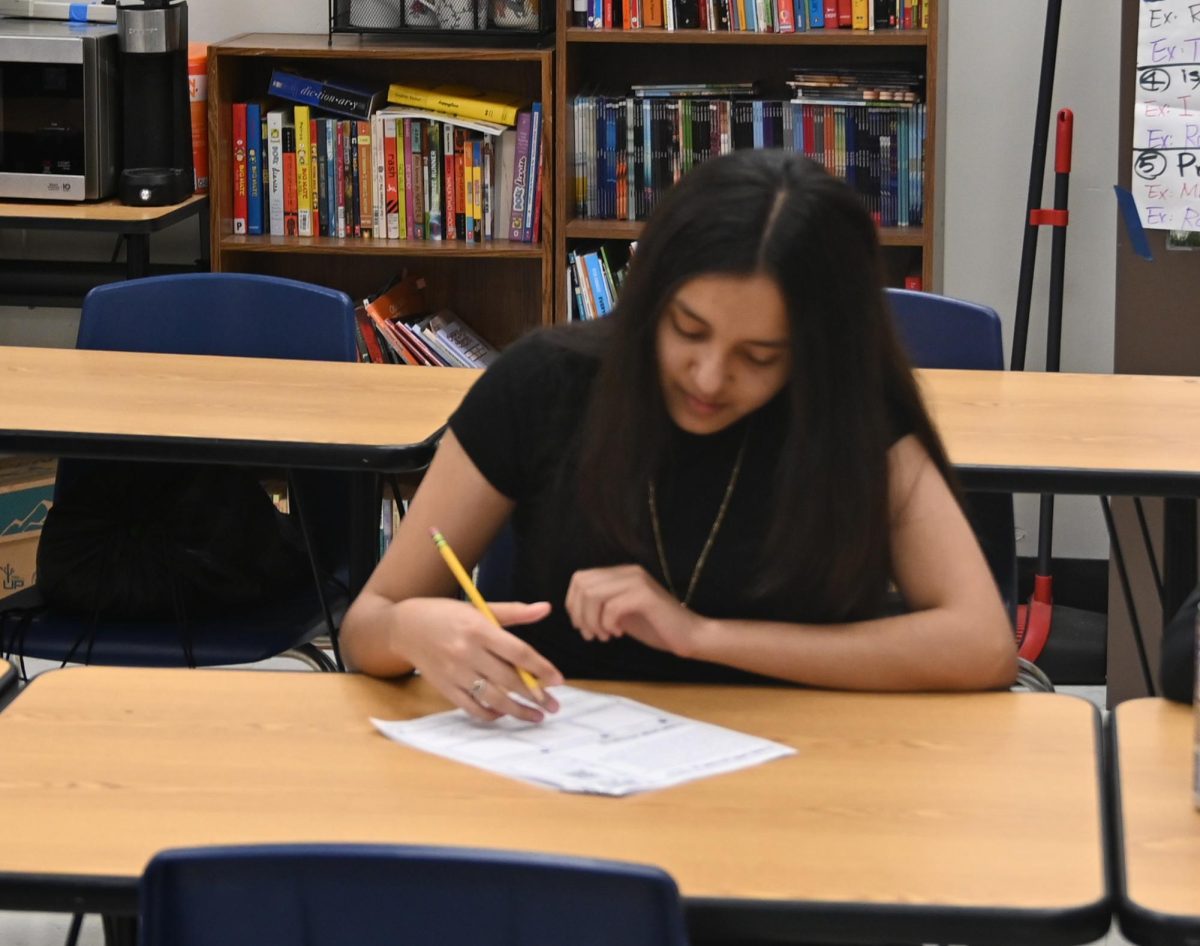
Many students say they have trouble with learning the English language, especially after moving from a new country. Freshman Ailin Tapia was born in Mexico, and she speaks Spanish as her primary language. She states that she has trouble learning, making new friends, and interacting with other people in general, due to the fact that she is not fluent in English.
“I find it frustrating to make new friends, because of the language barrier,” said Tapia.
Tapia says that it is harder to pick up information in high school rather than middle school, because of the lesser amount of support that is provided.
Although, she is not the only Spanish-speaking student who feels this way. Freshman Alison Contreras was also born in Mexico, and is mainly a Spanish speaker.
“I feel that it is an extra burden on teachers to translate the topic to me when I don’t understand,” said Contreras.
Contreras said not fully knowing the English language leads to some frustration.
“I think the most frustrating part is wanting to interact and communicate with people, but not being able to because I don’t really understand the language, or how to speak it,” said Contreras.
Michelle Ahuatzi was born in the United States but her mom was born in Mexico. Her mom told her she needed to learn English and Spanish. Ahuatzi said it was hard but she learned Spanish to talk with her family at home. She lives with her mom, dad, two sisters, and two brothers.
When Contreras, Ahuatzi and Tapia walk together in hallways they talk in Spanish, but it is often hard for Ahuatzi to understand what other students say when they talk in English.
“When I walk alone and I listen to English speakers talk or look at me, I feel uncomfortable because I feel like they are judging me,” Contreras said.
Tapia first arrived in the United States in seventh grade.
“In my first year at middle school, I didn’t do really well, but the next year I made friends who and I started to do well in English. It wasn’t easy, and it took time,” Tapia said.
Whitney Wilhelm is an ESOL teacher at South High. She said the number of Spanish speakers at South might be even larger.
“Many students at South High speak multiple languages, and you can only mark one language on Infinite Campus, so there may be even more Spanish-speaking students!” said Wilhelm.
Suzanne Johnson is also an ESOL teacher at South High.
“It is hard when there are a majority of students who speak one language and only a few who speak another language. The majority want to speak in their native language but it is important because the other students don’t understand what they are talking about so it is difficult for teachers and students. That is why we have a rule: Try your best to only speak English in class, so everyone feels welcome and can practice English together,” Johnson said.
![“All-Suburban [choir] was really fun because I got to work with a lot of people from other schools that I didn't know and I got to make friends. We got to learn fun but challenging music and perform for my parents so that was really fun. But the audition process was really stressful, because over 600 people auditioned but only around 150 actually made it into the choir so that was really intimidating for me. I was one out of three girls in my class who made it so that made me feel really special and I was really grateful to have this opportunity.”](https://psouthtreaty.com/wp-content/uploads/2026/05/Image_20260523_140845_694.jpeg)